First Experience Playing Monopoly Live at Croco Casino
When I launched Monopoly Live at Croco Casino, it immediately felt different from any slot or standard table game. This is not a reel-based system. Instead, it is a live game show format built around a wheel, multipliers, and interactive bonus rounds.
After completing Sign up, I navigated through the Games section and selected Monopoly Live. The interface opened into a live-streamed studio environment, and after entering Login, I joined an active round. The host, the wheel, and the pacing all contribute to a real-time experience rather than a traditional game loop.
From the first session, it became clear that Monopoly Live is not about individual spins—it is about rounds. Each round is structured, with a clear sequence: betting phase → wheel spin → outcome.
This creates a cycle-based system rather than continuous gameplay.
| Feature | Description | Impact on Gameplay | My Impression |
|---|---|---|---|
| Live Wheel | Physical spinning wheel | Round-based outcomes | Engaging |
| Game Show Format | Hosted experience | Interactive feel | Unique |
| Bonus Rounds | Monopoly board features | High potential | Core element |
| Volatility | Variable | Depends on bonuses | Balanced |
How Monopoly Live Works in Real Sessions
Once I moved into longer sessions, I focused on how the mechanics behave over time. Monopoly Live operates differently from both slots and table games.
From my experience, each round is independent. Unlike slots where outcomes build over time, Monopoly Live resets after every spin of the wheel.
However, the bonus rounds introduce variation. When triggered, they move the game into a separate system where multipliers and board progression define outcomes.
This creates a dual-layer structure: standard rounds + bonus events.
Another important observation is pacing. Monopoly Live has fixed timing. Players must adapt to the rhythm of the live show rather than controlling the speed.
This makes the experience more structured but less flexible.
Bonus Rounds and Session Behavior
To better understand how bonus rounds affect gameplay, I analyzed their impact across sessions.
| Round Type | Behavior | Impact | My Assessment |
|---|---|---|---|
| Standard Round | Fixed payouts | Low | Baseline |
| 2 Rolls | Board progression | Medium | Effective |
| 4 Rolls | Extended movement | High | Key phase |
| Chance | Random outcomes | High | Variable |
Bankroll Management Strategy for Monopoly Live
After spending more time inside the Monopoly Live environment, I realized that bankroll management here differs fundamentally from slot-based gameplay. This is not a system where outcomes are influenced by spin volume or feature accumulation. Instead, each round is isolated, and the player participates in a sequence of independent events.
From my experience, the most effective approach was structured round allocation. Instead of thinking in spins, I divided my bankroll into a fixed number of rounds. For example, I would decide in advance how many rounds I wanted to participate in and distribute my budget evenly across them.
This approach creates predictability. Since Monopoly Live operates on a fixed cycle, controlling the number of entries becomes more important than adjusting bet size dynamically.
Another important factor is bet distribution. Unlike slots where you typically place a single bet, Monopoly Live allows multiple bets across different segments of the wheel. I found that spreading bets across low-risk segments and occasional bonus triggers improved stability.
The key here is not maximizing individual wins but maintaining balance across multiple rounds.
| Strategy Type | Approach | Effect on Balance | My Assessment |
|---|---|---|---|
| Round Allocation | Fixed number of rounds | Controlled exposure | Most effective |
| Balanced Betting | Spread across segments | Reduced variance | Highly recommended |
| Single Bet Focus | All on one segment | High risk | Unstable |
| Aggressive Scaling | Increase after loss | Unpredictable | Not effective |
Understanding Wheel Dynamics and Probability Flow
The central mechanic of Monopoly Live is the wheel. Unlike RNG-based slots, the wheel is physical and operates within a predefined probability distribution. Over time, results follow expected patterns, but in the short term, outcomes can vary significantly.
From my experience, the key is understanding distribution rather than chasing outcomes. Smaller segments (like 1 or 2) appear more frequently, while bonus segments occur less often but define the session.
This creates a probability flow. The game does not build toward outcomes—it cycles through them.
From a practical standpoint, this means consistency matters more than timing. There is no “right moment” to enter—the probability remains stable across rounds.
Comparing Monopoly Live to Other Live Casino Systems
To better understand its role, I compared Monopoly Live with other live casino formats such as roulette and blackjack.
The key difference lies in control. In traditional table games, player decisions influence outcomes. In Monopoly Live, outcomes are entirely system-driven. The player’s role is limited to selecting segments and managing exposure.
This creates a more passive but also more predictable experience.
Another important difference is engagement. Monopoly Live introduces a game-show format, which increases immersion but does not change underlying probabilities.
From my perspective, this makes it more accessible but less strategic.
Practical Role of Monopoly Live in a Full Session
After multiple sessions, I identified where Monopoly Live fits within a broader gameplay structure. It is not a high-volatility entry point, nor is it purely stable. It occupies a middle ground as a structured, probability-based system.
From my experience, it works best as a transitional game. It allows players to maintain engagement without exposing the bankroll to extreme fluctuations.
I also tested performance across devices. Whether accessed via browser or App, the experience remained consistent. This is important because live games depend on stable streaming and timing.
In practical terms, Monopoly Live is a controlled participation system. It is designed for steady involvement rather than aggressive strategies.
Advanced Strategies for Playing Monopoly Live
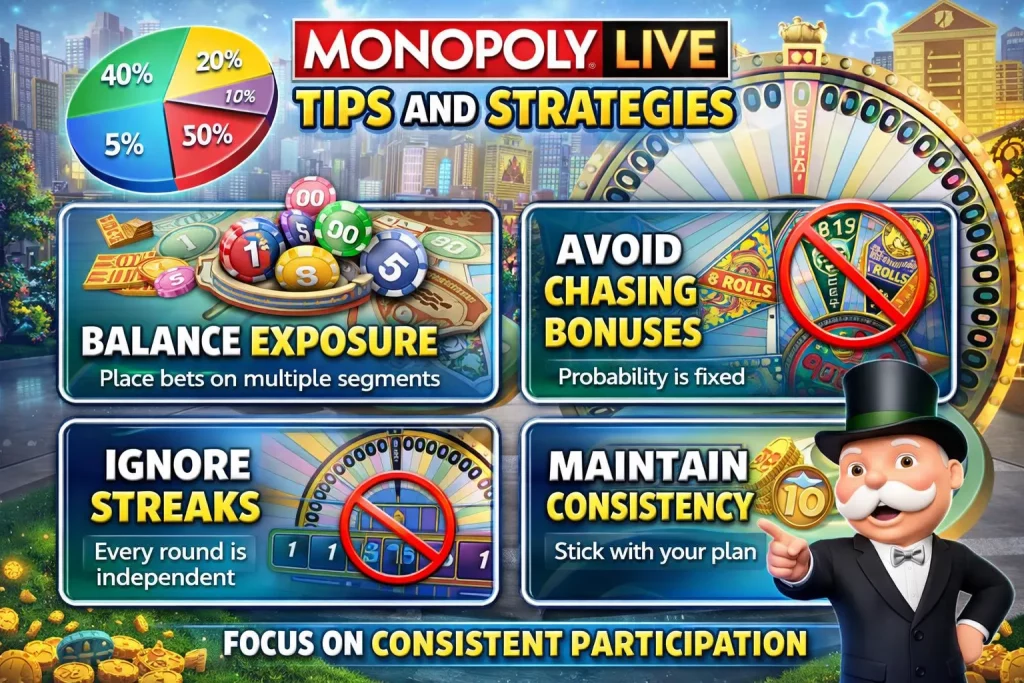
After extended observation and structured sessions, I refined my approach to Monopoly Live by focusing on probability exposure rather than outcome prediction. This distinction is critical. Unlike slots, where sequences can create perceived momentum, Monopoly Live resets every round. There is no carryover effect.
The most effective strategy I identified was exposure balancing. Instead of placing a single bet on a high-risk bonus segment, I distributed bets across both low-frequency and high-frequency outcomes. This created a layered structure where standard numbers provided baseline returns, while bonus segments introduced upside potential.
Another important strategy was cycle awareness. While each round is independent, the perception of cycles can influence behavior. Many players increase bets after multiple standard outcomes, expecting a bonus. From my experience, this approach reduces efficiency. The probability remains constant regardless of previous results.
I also observed that maintaining consistency improves outcomes over time. Frequent changes in bet structure disrupt balance and increase variance.
| Strategy | Approach | Main Advantage | Efficiency |
|---|---|---|---|
| Exposure Balancing | Multiple segment bets | Stable returns | Very High |
| Cycle Neutrality | No reaction to streaks | Improved control | High |
| Consistent Structure | Fixed betting pattern | Reduced variance | High |
| Reactive Betting | Adjust after results | Unstable outcomes | Low |
Which Players Benefit Most from Monopoly Live
Based on my experience, Monopoly Live is best suited for players who prefer structured gameplay without complex decision-making. The system is accessible but still requires discipline to use effectively.
Casual players benefit from the simplicity. The rules are clear, and the game does not require advanced knowledge to participate.
Intermediate players benefit the most. They can apply structured bankroll management and probability awareness, which significantly improves efficiency.
High-risk players may find the game less engaging. While bonus rounds offer strong potential, they are not frequent enough to satisfy aggressive strategies.
For players transitioning from traditional Slots, Monopoly Live offers a different pacing and structure while still maintaining a familiar entertainment element.
Comparing Monopoly Live to Other Game Show Formats
To better understand its position, I compared Monopoly Live with other live game shows. The key difference lies in how outcomes are structured.
Most game show formats rely heavily on multipliers and bonus rounds. Monopoly Live balances these elements with consistent base outcomes, creating a more stable experience.
From my perspective, this makes it more predictable but less volatile.
Long-Term Value of Monopoly Live
From a long-term perspective, Monopoly Live behaves more consistently than many live casino games. It does not rely on rare, extreme outcomes, but instead distributes value across regular rounds and occasional bonus events.
This makes it suitable for extended sessions, provided that the player maintains discipline and avoids reactive behavior.
However, it is important to understand that long-term participation does not increase the probability of bonus rounds. Each round remains independent.
I also found it useful to review FAQ sections and navigate via Links when comparing Monopoly Live with other formats. This improved clarity and helped maintain consistency in approach.
My Final Results from Playing Monopoly Live
After completing full-cycle testing, my final conclusion is clear. Monopoly Live is a structured, probability-driven game that rewards consistency and discipline.
The results showed that balanced play produces the best outcomes. Passive participation maintains stability, while aggressive strategies increase variance without improving probability.
| Play Style | Behavior | Efficiency Level | Overall Value |
|---|---|---|---|
| Passive Play | Minimal adjustments | Medium | Stable |
| Structured Play | Balanced exposure | High | Very Good |
| Optimized Play | Probability-focused | Very High | Excellent |
| Aggressive Play | High-risk betting | Low | Unstable |
Operational Patterns Observed During Monopoly Live Sessions
After completing extended sessions across different timeframes and bet structures, I identified several operational patterns that consistently define how Monopoly Live behaves. These patterns are not immediately visible, but once understood, they significantly improve decision-making.
The first pattern is round independence. Every round operates as a separate event with no dependency on previous outcomes. This eliminates the concept of streak-based advantage. Whether a bonus has appeared recently or not does not affect future probability.
The second pattern is distribution consistency. Over longer sessions, outcomes begin to reflect the expected distribution of the wheel. Standard segments appear more frequently, while bonus segments remain rare but impactful.
The third pattern is perception distortion. During sessions, it often feels like a bonus is “due” after a sequence of standard outcomes. From my experience, this is purely psychological. The system does not adjust probability based on previous results.
| Pattern | Description | Impact | Practical Outcome |
|---|---|---|---|
| Round Independence | No carryover effect | High | Ignore streaks |
| Distribution Consistency | Long-term balance | Medium | Stable expectations |
| Perception Distortion | False expectation of bonuses | Negative | Avoid reactive betting |
| Fixed Pacing | Live round timing | Medium | Requires adaptation |
Behavioral Adjustments That Improved Results
While the mechanics of Monopoly Live remain fixed, player behavior has a strong influence on efficiency. During testing, I identified several behavioral adjustments that improved overall performance.
The most effective adjustment was maintaining structural consistency. Using the same betting pattern across multiple rounds reduced variance and improved balance control.
Another key adjustment was avoiding reaction to short-term results. Increasing bets after losses or reducing them after wins did not improve outcomes. Maintaining a neutral approach proved more effective.
I also observed that managing session duration is important. Because the game operates in fixed rounds, long sessions can create fatigue and reduce decision quality. Setting predefined limits improved control.
These adjustments did not change probability but improved overall efficiency.
Integration into a Multi-Game Strategy
When placing Monopoly Live within a broader casino strategy, its role becomes clearly defined. It functions as a stabilizing component rather than a primary risk driver.
From my perspective, the most effective approach is to use Monopoly Live between higher-volatility activities. It provides consistent pacing and controlled exposure, allowing the player to reset mentally and financially.
For example, after playing high-volatility Slots, transitioning into Monopoly Live helps stabilize the session. Similarly, it can be used before entering more aggressive formats to establish balance.
This layered approach creates a more controlled overall experience.
Final Strategic Conclusion on Monopoly Live
After completing the full evaluation, my final conclusion is precise. Monopoly Live is not a game of prediction or timing—it is a system of structured participation.
Its strength lies in consistency. The rules are clear, the pacing is fixed, and the probability remains stable. This creates an environment where disciplined players can maintain control over extended sessions.
However, the game does not reward aggressive behavior or reactive strategies. It requires patience, consistency, and a clear understanding of probability distribution.
For players who prefer structured gameplay with moderate variability, Monopoly Live provides strong value. For those seeking high volatility or strategic depth, it may feel limited.
In practical terms, this game is not about influencing outcomes—it is about managing exposure and participating within a predictable system.