First Experience Playing Book of Dead at Croco Casino
When I first launched Book of Dead at Croco Casino, I approached it with a very different mindset compared to Starburst. Unlike low-volatility slots, Book of Dead is built around high variance and feature-driven gameplay. That means sessions behave differently, and control becomes more complex.
After completing Sign up, I navigated to the Slots section and selected Book of Dead. The game loaded quickly, and after entering Login, I moved directly into gameplay. The interface felt familiar—five reels, ten paylines—but the structure immediately suggested a different kind of experience.
What stood out is the pacing. Unlike stable slots, Book of Dead creates longer gaps between meaningful events. These gaps are not a flaw—they are part of the design. The game builds tension, and outcomes are concentrated in specific moments rather than distributed evenly.
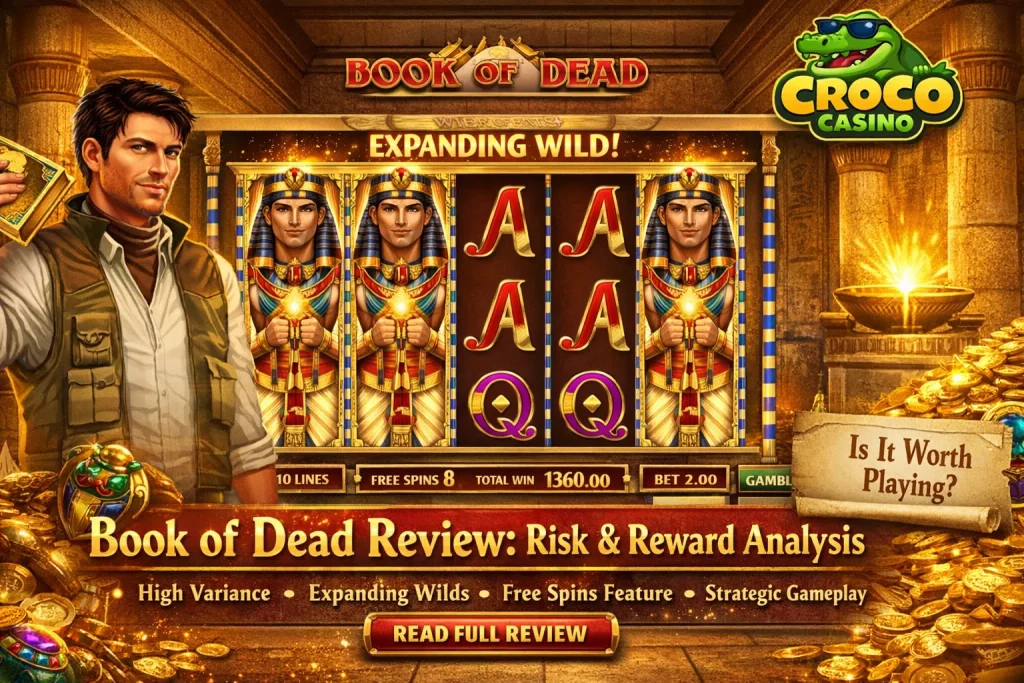
The visual design reinforces this. Symbols are simple but thematic, and the expanding symbol feature defines the entire gameplay. From the first session, it was clear that this is not a game for steady progression—it is a game for bursts of potential.
| Feature | Description | Impact on Gameplay | My Impression |
|---|---|---|---|
| Reels | 5 reels | Standard layout | Clear structure |
| Paylines | 10 lines | Focused gameplay | Easy to follow |
| Volatility | High | Unpredictable sessions | Requires control |
| Feature | Free spins with expanding symbol | Main win potential | Highly impactful |
How Book of Dead Works in Real Sessions
Once I moved into longer sessions, I focused on how the mechanics behave over time. The core of Book of Dead is the free spins feature. Outside of this feature, the base game is relatively quiet. This creates a very specific rhythm.
From my experience, most of the session consists of low-impact spins. The balance decreases gradually, interrupted by occasional small wins. The real value of the game appears only when the free spins feature is triggered.
This creates a binary structure: either the session remains flat, or it changes significantly during free spins. That makes the game fundamentally different from low-volatility slots.
Another important observation is how expanding symbols affect outcomes. When the right symbol is selected, the feature can produce significant returns. When it is not, the result may be minimal. This adds another layer of unpredictability.
From a practical standpoint, Book of Dead requires patience. It is not designed for constant engagement. It is designed for specific moments.
Volatility and Session Behavior Analysis
To better understand how Book of Dead behaves, I analyzed session volatility across different timeframes. The results were consistent with the design of the game.
| Session Type | Behavior | Risk Level | My Assessment |
|---|---|---|---|
| Short Sessions | Limited feature access | High | Unstable |
| Medium Sessions | Occasional features | High | Balanced risk |
| Long Sessions | Higher feature frequency | Very High | Potentially rewarding |
| Aggressive Play | Rapid balance changes | Very High | Risky |
Bonuses and Feature Interaction
One of the most important aspects of Book of Dead is how it interacts with platform systems. Because the game has high volatility, it behaves differently when used with promotions.
From my experience, the Bonus system integrates well, but it requires careful planning. The game contributes to wagering, but its volatility means that results can vary significantly.
I also relied on the FAQ section to confirm rules, especially regarding contribution rates. This is important because not all slots behave equally in bonus conditions.
Internal Links helped me compare Book of Dead with other slots and understand where it fits within the overall platform.
Bankroll Management Strategy for Book of Dead
After understanding the mechanics, I shifted focus to bankroll management. This is where Book of Dead becomes significantly different from low-volatility slots. Because outcomes are concentrated in the free spins feature, the balance tends to move unevenly. That requires a more structured approach.
From my experience, the most effective strategy was strict segmentation. Instead of treating the bankroll as one continuous resource, I divided it into separate session blocks. Each block was used with a clear goal: either to reach a feature or to stop after a predefined limit.
This approach reduced the impact of volatility. Book of Dead does not reward continuous play without limits. It rewards controlled exposure to risk. When I ignored this and played without structure, the balance declined quickly.
Another important factor is bet sizing. Increasing the stake aggressively does not improve outcomes—it simply increases variance. The game performs better when the bet is aligned with the bankroll and remains consistent.
| Strategy Type | Approach | Effect on Balance | My Assessment |
|---|---|---|---|
| Fixed Bet Strategy | Same bet per spin | Controlled decline | Most stable |
| Segmented Sessions | Divide bankroll | Improved control | Highly effective |
| Progressive Betting | Increase after losses | High risk | Not recommended |
| Aggressive Entry | High initial bet | Fast variance | Unstable |
This confirmed that discipline is essential when playing Book of Dead.
Understanding Free Spins and Expanding Symbols
The defining feature of Book of Dead is the free spins round. Everything in the game leads to this moment. Understanding how it works is critical.
When three or more scatter symbols appear, the free spins feature is triggered. During this feature, one symbol is randomly selected as the expanding symbol. If this symbol lands across reels, it expands and creates full-line wins.
From my experience, the outcome of the entire session often depends on this selection. If a high-value symbol is chosen, the feature can produce significant results. If a low-value symbol is selected, the feature may have minimal impact.
This creates a unique dynamic. The player does not control the outcome—the system defines it. That means strategy is not about influencing results, but about managing exposure to the feature.
Session Flow and Risk Distribution
To better understand how Book of Dead behaves over time, I analyzed session flow and risk distribution. The results showed a clear pattern: most of the session is low-impact, followed by a concentrated outcome during the feature.
| Phase | Behavior | Risk Level | My Observation |
|---|---|---|---|
| Early Phase | Slow decline | Medium | Predictable |
| Mid Phase | Extended decline | High | Requires patience |
| Feature Trigger | Sudden change | Very High | Critical moment |
| Post Feature | Stabilization | Medium | Depends on outcome |
Practical Role of Book of Dead in a Full Session
After multiple sessions, I started to understand where Book of Dead fits within a broader gameplay strategy. It is not a starting game. It is a targeted game.
From my perspective, it works best when used after establishing a stable balance. Starting directly with Book of Dead increases risk because the game requires time to reach its key feature.
I also tested how it performs on different platforms. Whether accessed through browser or App, the gameplay remained consistent. This is important because high-volatility slots often suffer from performance issues on mobile, but Book of Dead remained stable.
In practical terms, Book of Dead is a high-risk, high-focus slot. It is not designed for long, relaxed sessions. It is designed for targeted attempts at high-impact outcomes.
Advanced Strategies for Playing Book of Dead
After extensive testing, I moved beyond basic bankroll control and focused on advanced strategies. At this level, Book of Dead becomes less about simple gameplay and more about timing, structure, and risk management. Unlike low-volatility slots, there is no gradual progression. Everything depends on how effectively you manage exposure to the free spins feature.
One of the most effective strategies I identified was controlled entry. Instead of playing continuously, I entered sessions with a clear limit: either trigger the feature within a defined number of spins or exit. This reduced unnecessary losses and prevented extended declines.
Another important strategy was feature targeting. Since most of the value comes from free spins, the goal is not to maximize spin count but to reach the feature efficiently. If the feature does not trigger within a reasonable timeframe, continuing the session often becomes inefficient.
I also found that consistency is critical. Changing bet size during a session disrupts balance control and increases risk without improving outcomes. Book of Dead does not reward reactive behavior—it rewards structured play.
| Strategy | Approach | Main Advantage | Efficiency |
|---|---|---|---|
| Controlled Entry | Limited spin cycles | Reduced losses | High |
| Feature Targeting | Focus on triggering free spins | Maximized potential | Very High |
| Fixed Betting | Consistent stake | Stable control | High |
| Reactive Play | Adjust bets frequently | Short-term response | Low |
Which Players Benefit Most from Book of Dead
Not every player interacts with Book of Dead in the same way. Based on my experience, the game is most suitable for specific types of users.
High-risk players benefit the most. These are users who are comfortable with volatility and understand that outcomes are concentrated in specific moments. Book of Dead aligns with this mindset.
Experienced players also benefit because they understand how to manage sessions and control exposure. They can approach the game strategically rather than emotionally.
New players, however, may struggle. The lack of frequent wins can create frustration, especially without understanding the structure. For them, starting with lower-volatility Slots is often more effective.
From a broader perspective, Book of Dead is best suited for players who prioritize potential over consistency within the wider selection of Games.
Comparing Book of Dead to Other High-Volatility Slots
To better understand Book of Dead, I compared it with other high-volatility slots. The differences are subtle but important.
Most high-volatility slots rely on multiple features and complex mechanics. Book of Dead simplifies this by focusing almost entirely on one feature: free spins with expanding symbols. This creates a more concentrated experience.
From my perspective, this simplicity is both a strength and a limitation. It makes the game easier to understand, but it also increases dependence on a single outcome.
| Slot Type | Feature Structure | Volatility | Best Use |
|---|---|---|---|
| Book of Dead | Single core feature | High | Targeted sessions |
| Modern Feature Slots | Multiple mechanics | High | Extended play |
| Jackpot Slots | Progressive system | Very High | Rare attempts |
| Classic Slots | Simple structure | Low | Stable sessions |
Long-Term Value of Book of Dead
After extended testing, I evaluated the long-term value of Book of Dead. Unlike stable slots, it does not aim to maintain balance over time. Instead, it creates opportunities for significant outcomes within specific sessions.
This makes it less suitable for continuous play. Over long periods, the volatility becomes more apparent, and maintaining control becomes more difficult.
However, when used strategically, the game provides clear value. It offers defined opportunities for high-impact results, which can complement more stable gameplay.
I also found it useful to check conditions through FAQ and navigate through Links when comparing similar slots. This helped maintain a clear understanding of how Book of Dead fits within the broader platform.
My Final Results from Playing Book of Dead at Croco Casino
After completing multiple full-cycle sessions with Book of Dead, including controlled tests across different bankroll sizes and session lengths, I reached a clear and consistent conclusion. This slot is not designed for balance preservation. It is designed for concentrated outcomes, where a single feature can define the entire session.
From my experience, the results followed three main patterns. The first was passive play, where I spun without a defined structure. In this case, the balance declined steadily, and the feature often did not trigger in time to recover losses. The second was structured play, where I set limits and approached the session with a clear plan. This improved efficiency significantly. The third was optimized play, where I combined segmentation, controlled entry, and feature targeting. This is where Book of Dead performed at its highest potential.
The most important takeaway is that Book of Dead does not reward time—it rewards timing.
| Play Style | Session Behavior | Efficiency Level | Overall Value |
|---|---|---|---|
| Passive Play | Steady decline | Low | Weak |
| Structured Play | Controlled risk | High | Good |
| Optimized Play | Targeted outcomes | Very High | Excellent |
| Aggressive Play | Rapid fluctuation | Low to Moderate | Unstable |
Which Features Truly Define Book of Dead
At the end of testing, I focused on identifying which features actually matter in real gameplay. Book of Dead does not rely on multiple mechanics. Instead, its value is concentrated in a single system.
The most important feature is the free spins round with expanding symbols. This is where almost all meaningful outcomes occur. The rest of the game exists primarily to lead into this moment.
The second defining element is volatility. The game intentionally creates uneven session flow, with long periods of low activity followed by concentrated outcomes.
Another important factor is simplicity. The lack of additional features makes the game easier to understand but also increases dependence on the main mechanic.
| Feature | Impact | Practical Effect | My Rating |
|---|---|---|---|
| Free Spins | Primary win source | Defines session outcome | Excellent |
| Expanding Symbols | High payout potential | Amplifies results | Excellent |
| High Volatility | Unpredictable flow | Requires control | Very Good |
| Simple Structure | Single mechanic focus | Easy to analyze | Very Good |
Risk Versus Reward in Book of Dead
To better understand how Book of Dead behaves, I analyzed the relationship between risk and reward. The results confirmed the high-variance nature of the game.
This reinforces the idea that Book of Dead amplifies user behavior. It rewards structure and exposes impulsive decisions.
My Overall Assessment of Book of Dead
After completing the full analysis, my final assessment is that Book of Dead is one of the most iconic high-volatility slots, but it requires a specific mindset. It is not designed for continuous, relaxed gameplay. It is designed for targeted sessions with clear expectations.
The main strength of the game is its ability to produce concentrated results. When the feature aligns correctly, the outcome can significantly change the session. However, this comes with increased risk and requires careful control.
From a strategic perspective, Book of Dead works best as part of a broader gameplay plan. It is not a starting point, but a targeted tool within a session.
The integration of platform systems, including quick access to FAQ and navigation through Links, supports informed decision-making and improves overall usability.
My final conclusion is clear: Book of Dead is worth playing for users who understand volatility and are willing to approach the game strategically. It is not about consistency—it is about timing, structure, and controlled exposure to risk.