
My First Impression of the Croco Casino Sign up Offer
When I first tested the Croco Casino Sign up offer, I approached it with one main question in mind: does it actually help a new player start in a controlled and useful way, or does it simply look attractive on the registration page? That is always the real test. A sign-up offer should not only create excitement. It should make the first sessions more manageable, more transparent, and more worthwhile for someone who is still learning how the platform behaves.
At Croco Casino, the onboarding path felt relatively clean. The first contact with the offer happens during registration, when the account is being created and the platform starts linking the new profile to its opening promotions. What matters here is not just the existence of the offer, but how smoothly it connects the user from registration into the first deposit and first promotional session. From my experience, that flow worked best when I treated it as a structured start rather than a rush toward the largest possible reward.
The sign-up offer felt closely tied to the first account experience. That means it influenced several things at once: how much promotional value appeared at the start, how I viewed the first deposit, and how carefully I had to separate real funds from offer-based balance. I found that this kind of offer is easiest to use well when you stop thinking of it as free money and start treating it as a controlled entry framework.
Another thing I noticed right away is that the sign-up offer is not just about the reward size. It is also about how clear the platform makes the early promotional rules. If the registration path is simple but the reward structure is confusing, the whole value drops. In this case, I found the early account experience readable enough to start evaluating the offer as a practical tool rather than just a banner promise.
| Sign Up Offer Element | What I Checked | Why It Matters | My First Impression |
|---|---|---|---|
| Registration Flow | How easy the account setup felt | Defines the onboarding quality | Clear and usable |
| Offer Trigger | When the reward became available | Shows how practical the start is | Important for first session planning |
| Balance Structure | How promo and real funds appeared | Prevents false expectations | Must be watched closely |
| Tracking Visibility | How easy the offer was to monitor | Helps control early sessions | Very relevant |
How the Sign-Up Offer Usually Works in Practice
After the first impression, I focused on what actually happens once the account is live. In practice, a sign-up offer only becomes meaningful when it connects smoothly from account creation into a first usable session. A lot of casinos advertise attractive onboarding rewards, but the actual transition from registration to gameplay is where the offer either proves its value or loses it.
From my experience, the process became practical in three stages. First, the new account was created and confirmed. Second, the initial promotion path became visible as part of the early account structure. Third, I had to decide whether to move directly into deposit-based activation or first observe how the platform presented the offer details. That third step matters more than it seems. Players who rush directly into the first deposit often misunderstand what part of the offer is immediately useful and what part still depends on conditions.
What I found most useful was slowing the process down. Instead of treating the sign-up offer as an instant green light to play aggressively, I treated it as a framework to understand the platform. This made it easier to judge whether the promotion was well balanced or whether it simply enlarged the displayed account value without making the session more usable.
I also noticed that after Login, the account became much easier to interpret once I checked the balance structure carefully. That habit helped me understand what part of the offer belonged to the real-money side and what part belonged to the promotional side. Without that distinction, the sign-up offer can feel larger than it really is.
Why the Sign-Up Offer Feels Different from a Standard Welcome Bonus
Although the sign-up offer overlaps with the broader welcome structure, I found it useful to think of it a little differently. A standard welcome Bonus is usually judged by size, stages, or attached spins. A sign-up offer feels more immediate and more psychological. It shapes the first impression of the account itself. It is the first promotional promise tied directly to the user profile rather than just the deposit.
That difference matters because the sign-up offer is not only about money. It is about confidence. If the opening offer is easy to understand, new users feel more in control. If it is oversized or unclear, the first session becomes more stressful. From my own testing, the Croco Casino sign-up offer felt strongest when I treated it as an onboarding guide, not just a reward layer.
This also affected how I approached game choice. I did not want to jump too widely across the Games section just because a promotion was active. Instead, I used the offer as a reason to stay focused and observe how the casino behaved under real conditions. That mindset made the first sessions more useful and stopped the offer from turning into noise.
| Offer Type | Main Timing | Main Effect | How I Viewed It |
|---|---|---|---|
| Sign Up Offer | At account creation | Shapes the first platform experience | Onboarding tool |
| Welcome Bonus | After first deposit | Adds promotional balance | Session extension tool |
| Reload Promotion | Later deposits | Supports retention | Repeat-value tool |
| Cashback Offer | After losses | Softens session pressure | Recovery tool |
This comparison helped me separate the emotional impact of joining the site from the more technical structure of later promotions.
My Early Strategy for Using the Sign-Up Offer Well
Once I understood the opening structure, I adjusted my strategy immediately. The worst way to use a sign-up offer is to treat it like permission to play too freely. In my experience, the best way is almost the opposite: play more carefully than usual at the start. That gives the offer time to show whether it is genuinely helpful.
My first rule was to keep stakes low until I understood how the opening balance was behaving. My second rule was to focus on efficient Slots rather than jumping into high-variance titles too quickly. My third rule was to treat the first sessions as evaluation sessions, not as a race toward a short-term result.
That approach helped a lot. The sign-up offer stopped feeling like a marketing promise and started functioning as structured session capital. I also found it easier to monitor the early account state through the main interface and the App, especially when checking how the initial reward had been attached and how the first session was unfolding.
How the Sign-Up Offer Behaved Across Multiple Sessions
After the first stage of testing, I stopped judging the Croco Casino Sign up offer by its opening impression alone and started looking at how it behaved over several sessions. That is where the real quality became visible. A strong first impression can be created by almost any onboarding campaign, but only repeated use shows whether the offer is actually useful or just visually appealing.
From my experience, the sign-up offer usually settled into three broad outcomes. The first was low-impact value, where the reward looked helpful at the beginning but faded too quickly to change the account experience in a meaningful way. The second was workable value, where the sign-up structure extended the first sessions and made the account easier to explore with discipline. The third was strong structured value, where the sign-up reward, game choice, and session pacing aligned well enough to create realistic conversion potential.
What became clear very quickly is that the best sign-up structures were not necessarily the biggest ones. More often, they were the ones that stayed clear, proportional, and easy to manage. That mattered much more than headline scale.
| Sign Up Offer Outcome | How It Felt | Session Support | My Assessment |
|---|---|---|---|
| Low-Impact Value | Useful at first, fragile in use | Low | Mostly cosmetic |
| Workable Value | Improved the first sessions noticeably | Medium | Practically useful |
| Strong Structured Value | Supported controlled play very well | High | Very useful |
| Overstated Opening Offer | Looked strong, felt heavy | Mixed | Depends on conditions |
Which Sign-Up Structures Felt Most Usable
Once I had enough sessions behind me, I began comparing sign-up structures rather than treating all of them as the same type of reward. This made evaluation much easier. Some opening offers felt naturally integrated into the account experience, while others created too much pressure right away and actually made the first sessions harder to manage.
The most usable sign-up structures were the ones that kept the onboarding logic simple. Balanced introductory offers worked better than oversized structures because they gave enough room to explore without creating unrealistic expectations. If a sign-up package was tied cleanly to a first deposit and a manageable promotional balance, it felt useful. If the structure became too heavy too early, the account felt more stressful instead of more inviting.
I also found that sign-up offers including spins could be worthwhile, but only when those spins were linked to sensible titles. If the assigned slot was too volatile, the extra layer of the promotion often made the first session feel less stable rather than more rewarding. That is why clarity mattered almost as much as size.
This stage of testing pushed me toward a simple conclusion: the best sign-up offers are the ones that help the player understand the platform while still giving enough room to play with structure.
How I Judged Whether the Sign-Up Offer Was Really Helping
To evaluate the sign-up offer properly, I used a simple standard: did it actually improve the first account experience in a useful way? If the answer was yes, then the offer had real value. If the reward simply made the displayed balance look larger without making the platform easier or more stable to use, then its practical value was much lower than the headline suggested.
This is where I paid close attention to how the account looked after Login, how the promotional and real balances were separated, and how easily I could move into a stable session without unnecessary pressure. I also noticed that game choice mattered a lot. When I stayed focused on efficient Slots, the sign-up structure felt much stronger. When I drifted too far across the wider Games area, the promotion often became less helpful because the session lost its rhythm.
That is why I no longer rate a sign-up offer by the number attached to it. I rate it by how much easier it makes the opening experience to manage. If it creates clarity, extends session control, and supports realistic play, then it is useful. If it mainly adds temptation and confusion, then the value is weak.
| Evaluation Standard | What I Asked | Why It Helped | Result |
|---|---|---|---|
| Session Extension | Did the offer add real playable time? | Measures practical usefulness | Very useful |
| Pressure Reduction | Did it make the start easier to manage? | Shows real structural value | Important |
| Balance Clarity | Was promo value easy to understand? | Prevents false expectations | Essential |
| Conversion Realism | Did the structure make withdrawal plausible? | Tests final strength | Most important |
These standards made it very easy to separate a strong sign-up offer from a merely attractive one.
Why the Sign-Up Offer Can Improve Play Without Guaranteeing Profit
One of the most important lessons from this stage is that a sign-up offer can still be valuable even when it does not lead directly to a cashout. In real casino use, that is often not its primary role. A good sign-up structure improves the first sessions, reduces uncertainty, and gives the player more room to learn how the platform works. That alone has value.
This is especially true when the offer makes it easier to explore selected Slots, understand the balance structure, and move through the early casino experience without feeling lost. That kind of support is worth something even if the promotion does not immediately produce a winning withdrawal.
Bankroll Strategy When Using the Croco Casino Sign up Offer
Once I had tested the Croco Casino Sign up offer across several sessions, I realized that the biggest mistake would be treating it like ordinary balance. That is where much of the value disappears. A sign-up offer can make the account look stronger right away, but if I use it as if every part of that balance were unrestricted cash, the early advantage fades very quickly. From my experience, the best approach is to treat the sign-up offer as structured entry capital, not as instant freedom.
The first thing I did was divide the promotional value mentally into smaller sections. I did not want one long first session where a few weak rounds could erase most of the opening structure. Instead, I treated the offer as several controlled attempts to build stability and learn how the platform behaves. That made the whole account feel calmer and more manageable.
This segmentation approach changed the way the sign-up offer felt. Instead of a fragile opening gift, it became a framework for disciplined exploration. I was no longer trying to force the biggest result immediately. I was trying to preserve the usefulness of the offer long enough for it to matter.
| Bankroll Method | How I Used It | Main Benefit | Risk Level |
|---|---|---|---|
| Full Offer Play | Use the whole opening structure at once | Fastest possible progress | High |
| Segmented Sessions | Divide the sign-up value into parts | Better control and lower pressure | Moderate |
| Micro Session Play | Use very small portions at a time | Maximum discipline | Low |
| Pressure Play | Increase aggression to force quick gains | Possible short-term spike | Very High |
From everything I tested, segmented sessions produced the best balance between stability and progress.
How I Controlled Bet Size During Opening Sessions
Bet size was the next major variable. Once the sign-up offer was active, I noticed how easy it would be to overbet simply because the balance looked larger than usual. In my experience, that is the point where many onboarding rewards stop being useful. The best opening offers should usually be played more carefully than a normal deposit session, not less carefully.
So I used a phased stake model. At the start, I kept bets low and watched how the balance behaved. If the session stabilized, I stayed near the same level. Only later, and only when the structure of the session looked manageable, did I allow a modest increase. The goal was not to chase a huge result right away. The goal was to keep the sign-up offer alive long enough to remain useful.
That approach made the first sessions feel much stronger than aggressive early betting.
Which Games Worked Best with the Sign-Up Offer
After repeated testing, I found that the sign-up offer worked best when paired with a narrow group of reliable Slots rather than wide experimentation. The strongest results came from low- and medium-volatility slot titles with decent RTP and enough base-game activity to keep the balance moving without extreme swings.
This mattered more than I expected. When I kept the game pool focused, the sign-up structure felt much easier to manage. When I moved too fast into high-variance titles or jumped around the broader Games section too quickly, the session became fragile and the offer lost much of its practical value. Exploration may still be interesting, but the opening reward works best when it is given discipline.
That is why I eventually stopped trying to make the sign-up offer work equally well across every type of game. Some titles clearly support structured onboarding better than others.
| Game Style | Volatility | Best Use with Sign Up Offer | Practical Efficiency |
|---|---|---|---|
| Stable Slot Titles | Low | Early and mid session | Very High |
| Balanced Video Slots | Medium | Main opening sessions | High |
| Feature-Heavy Slots | Medium to High | Late session only | Moderate |
| High-Variance Titles | High | Rarely useful early | Low |
The pattern stayed consistent: the calmer the slot profile, the more useful the sign-up offer felt.
Why Shorter Sessions Made the Sign-Up Offer More Effective
Another major pattern I noticed is that the sign-up offer worked much better in shorter, focused sessions than in one long attempt to extract all the value at once. Long sessions increased emotional play, encouraged drifting stakes, and made the whole opening structure less clear. Short sessions kept everything easier to judge.
That is why I often paused after one controlled segment and returned later through Login with a clearer mindset. This made the sign-up offer feel less like an urgent race and more like a structured introduction to the platform. The Croco Casino App also helped here because it made it easy to check the account state, see how the opening reward had been attached, and continue in shorter bursts when needed.
My Final Results from Using the Croco Casino Sign up Offer
After testing the Croco Casino Sign up offer across multiple sessions, different game selections, and several bankroll strategies, I reached a clear conclusion: the offer can be genuinely useful, but only when it is treated as structured onboarding value rather than as ordinary playable cash. That distinction shaped every strong result I saw.
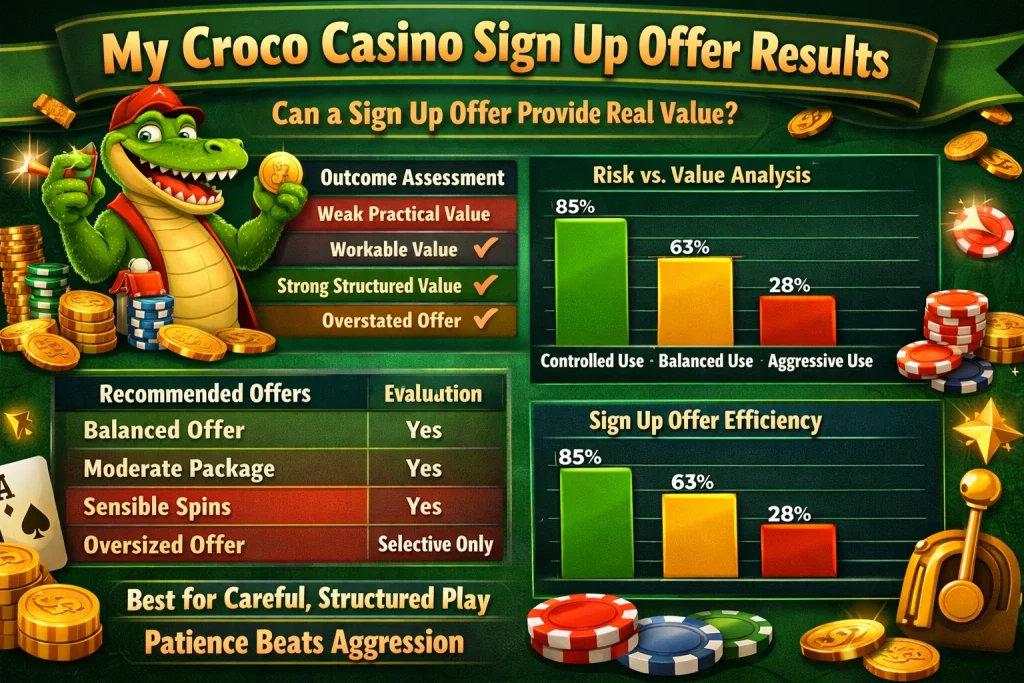
From my sessions, the outcomes usually fell into three broad patterns. The first was weak practical value, where the offer looked attractive during registration but faded too quickly to improve the first real sessions. The second was workable value, where the opening reward extended play, reduced pressure, and helped me understand the platform with more control. The third was strong structured value, where the sign-up offer genuinely improved the first account experience and created realistic conversion potential.
What stood out most is that the strongest results did not come from the biggest-looking opening structure. More often, they came from balanced sign-up offers that matched the account rhythm and were used with controlled stake sizing.
| Result Pattern | How It Felt in Practice | Conversion Potential | Overall Value |
|---|---|---|---|
| Weak Practical Value | Strong headline, limited real effect | Low | Limited |
| Workable Value | Improved the first sessions clearly | Medium | Good |
| Strong Structured Value | Supported disciplined onboarding very well | High | Very Good |
| Overstated Offer | Looked large, converted poorly | Mixed | Depends on rules |
That is why I now judge a sign-up offer by how useful it remains after registration, not by how impressive it looks on the registration page.
Which Sign-Up Offer Structures I Would Actually Use Again
By the end of testing, I found it easy to answer the most practical question: which sign-up-offer structures would I personally want to use again? My answer was not “the biggest ones.” It was the ones that felt clear, proportional, and realistic within normal play.
Balanced sign-up structures worked best. They created enough value to improve the first sessions, but they did not overload the account with unrealistic pressure. Moderate opening offers tied cleanly to a first deposit and a manageable promotional layer felt much more reusable than oversized onboarding campaigns that tried to do too much at once.
I would also be willing to use sign-up offers again when they included sensible spins on stable titles, because those helped me understand the platform without distorting the entire account balance. By contrast, huge one-shot opening offers often looked exciting but felt more difficult to justify in practical terms.
| Sign Up Structure | Repeat Value | Ease of Use | Would I Use Again? |
|---|---|---|---|
| Balanced Sign Up Offer | High | High | Yes |
| Moderate Opening Package | Medium to High | Medium | Yes |
| Sign Up Offer with Sensible Spins | High | Medium to High | Yes |
| Oversized One-Step Offer | Medium | Low to Medium | Only selectively |
That repeatability mattered more than headline size. A sign-up offer becomes strong when it fits the real shape of the first account sessions.
Risk Versus Value in Real Sign-Up-Offer Play
To make the final picture clearer, I compared different styles of sign-up-offer use against the practical value they produced. The result matched everything I saw in real play: lower-risk, more controlled use created the strongest long-term efficiency.
That is the clearest lesson from the whole process: the Croco Casino Sign up offer rewards patience and structure far more than speed.
My Overall Assessment of the Croco Casino Sign Up Offer
After going through the full cycle — from registration to repeated early sessions, game testing, and conversion analysis — my final view is that the Croco Casino Sign up offer is a genuinely useful onboarding tool when approached realistically. It is not just a flashy opening banner. It can improve the first account experience in a practical way if the player stays disciplined and understands that promotional value is not the same as cash.
The real strength of the sign-up offer is not that it guarantees profit. It is that it makes the first sessions more manageable, gives more room to test efficient Slots, and helps a new user understand how the platform works without immediate full-pressure play. Its value depends on the attached rules, the chosen games, and the patience of the player.
I also found that support tools mattered more than expected here. The FAQ section was useful whenever I needed to verify the onboarding conditions, and Links helped me compare the sign-up page with related promotional routes. Those small habits made the offer easier to trust and much easier to use correctly.
My final conclusion is simple: the Croco Casino Sign up offer is worth using, but only with realistic expectations. It is not instant profit, and it is not best approached aggressively. It is structured entry value. Used carefully, it becomes one of the most useful ways to begin exploring the platform.